Cool Stuff To Check Out From J and B

Wednesday, October 27, 2010

October 13, 2010: TWO NEPALS

Nepal has been a journey of extremes from the poverty and assault on the senses in Kathmandu to the human strength and capability reflected in the hearts and flesh of the Buddhist Sherpas. In Nepal we have seen the best and worst of humanity. While in Bali and Thailand we grew to understand more about Hinduism, in the Himalayas we began a journey into the Buddhist traditions. Our bodies experienced 18 days of high-altitude trekking, culminating in a breath-taking heavy-footed height of 18,200 feet. We touched greatness in the form of the two Erics from Boulder...Eric Larsen, who summited Everest days after we visited him at basecamp (and now has fulfilled his lofty goal of reaching the „three poles“ in a year’s time), and Eric Weinmyer (also an Everest summiter), who was leading a group of disabled military veterans to the peak of Lobuche. In our reflections on Nepal, this land of such extremes, we ponder the relevance of Buddha’s teachings of „the middle way.“

Brief History Lesson
The Kingdom of Nepal, as it was known for centuries, is a land that shares a southern border with India, and has many similarities to it's neighbor. Yet, lest we forget, Nepal was never a British colony; and to be sure, it is in a different time zone...15 minutes later than India. In Kathmandu, the capital and historically the heartbeat of Nepal, streets are filled with Hindus donning red tiki-dotted foreheads, brightly colored saris, and men hanging out of suffocatingly packed local buses. Scratching under the surface, though, we find that Nepal is a blending of Buddhism and Hinduism, castes and karma, prayer flags and deities. The city stupas, including Bod'nath near which we slept at the Dragon Guesthouse, are centers of Buddhism, often populated by red-robed bald-headed Tibetan Buddhists, many of whom are in exile. Sidartha Gautama (Buddha) was born in the Kingdom in the 6th century BC, but swiftly left to tour what is now northern India, and it wasn't until the 5th century AD through the marriage of a Nepali King to his Chinese Buddhist sweetheart that the land of Nepal became Buddhist. Oh, the power of love! Nepal went through a protracted dark age until establishing a prosperous trade route through Kathmandu, marking the beginning of the golden age and wealth for Nepal. The centuries-long Hindu Shah dynasty began in the 1700's. The first Shah king, using his ruthless and skilled Gurka fighters, conquered and united all of Nepal, and kept the Shahs in power in varying degrees up until the 1900s. Following this major (and bloody) unification, Nepal cut itself off from the outside world between 1812-1951. In the meantime, up to 300,000 Nepalis fought in World Wars I and II for the Allied troops. Upon opening it's doors in 1951, Sir Edmund Hillary and Tenzing Norgay Sherpa promptly made history with their Everest summit at the height incompatible with life of 29, 035 feet (8,850 meters).
Politically, the now Republic of Nepal became a democracy in 1990, or what would be a decade of corruption under the guise of democracy. In 1998, the communist Maoist party was elected (yes, election of a communist party) with an overwhelming majority based on it's promises to support the people, who had lost any faith and trust in the current „democracy“. The Maoists had been fighting the "People's War" by terrorist means for the last decade. (The U.S. had siphoned billions of dollars to the government of Nepal to fight the Maoist terrorists, the same organization who now hold the power.) Two years later, Nepal still awaits a new constitution draft and the support and services promised.

THE FIRST NEPAL: KATHMANDU
Brett and I were quite aghast on our arrival to Kathmandu at the physical, social and political conditions. The city is a sprawl of clay brick buildings of no more than four to five stories high in various levels of disrepair and dilapidation. The infrastructure is poor with narrow pitted dirt roads, inadequate traffic control, and crowds of people spilling into streets due to lack of walkways. Trash collection is inadequate, and rolling black-outs of electricity occur regularly. Our first meal, at the Yak Restaurant, was complete with a rat at our feet and roaches crawling across the food preparation area. Although we came out unscathed, we stuck to more upscale joints like Flavors Cafe on the Bod'nath Stupa square. The square was our respite, complete with resident cow, a flock of doves, monasteries, incense-filled air, and elderly women circumabulating the stupa clockwise while turning the prayer wheels and whispering to Buddha, Shiva and Brahman. The social conditions are no better. Trafficking of girls is not uncommon, and women have few rights. Only 33% of women are educated compared to 67% of men, which keeps women at home, in the fields, and subordinate to men. One of the young U.S. tourists, a college student we met along the way, had a frightening experience being pressed between men on a crowded bus and fondled. As we had heard such amazing things about Nepal, Kathmandu was shockingly uncomfortable place to travel, especially for me as a woman. Orphanages that house the clusters of city street children can do little more than put a roof over their heads and provide a diet with little nutritional value. The prospect of providing a bright future for these children are slim. Health care, from clean water, to access to care for the largely rural population, to availability of modern technology and medicine, are pipe dreams for most Nepalese. We found a retired Nepali economist named Ram at the Bod‘nath stupa who publishes a journal called „Quarterly Development Review“. He has, in his retirement, dedicated himself to creating awareness of the social and political issues of Nepal, many aforementioned. He is also accruing Hindu karma points in the process!

Frankly speaking, Kathmandu was a necessary evil en route to our big Himalayan adventure which was to start at the domestic terminal of the Tribhuvan International Airport in Kathmandu. We were filled with excitement on our way to the airport. Four days later, we found ourselves dragging ourselves out of bed, repacking our backpacks and returning to the crowded and increasingly irritated mob of travelers in the Tribhuvan airport, with little hope that the weather had cleared in our Himalayan destination Lukla, in order to land at the most dangerous airstrip in the world. And to add to our experience, we learned that two planes had crashed in the last two months, killing most people aboard due to poor visibility and difficult landing conditions. The icing on the cake was when we were finally offered the last two seats on a plane to Lukla. On this fourth day (of what was becoming hell), the corrupt man working behind the Nabil Bank counter refused to stamp our tickets to show we had already paid the airport tax. I paid him again, and he took my money and handed me our tickets back STILL unstamped. In disbelief and almost in tears, they escorted me away from the counter. Brett returned, and the crook of a man took even more of our money from Brett before finally giving us a stamp. On the bright side, during these four days we got a chance to get to know Gopal Chetri, our faithful cab driver with the Ganesh charm hanging from his rear-view mirror, who was to be found every morning waiting near the Bod‘nath stupa. He is one of one million Nepali men that has had to leave Nepal at different times to find work. Our proprietors at the Dragon Guesthouse always welcomed us back with a warm welcome and a shared look of pity for our plight. And we made friends with fellow travelers who were stranded with us.

THE SECOND NEPAL: THE HIMALAYAS

~"Nowhere else are the earth and sky so alive. The glaciers melt, rocks tumble, cold wind cuts through ravines and across bluffs. The Himalayas are an amalgam of growth and destruction, as shifting earth pushes the peaks skyward, and the elements and human activity simultaneously work the earth, the stone, the waters slowly back down, right before the eye."

The fog finally cleared, we landed safely at the Tenzing-Hillary Lukla airport, and we began the journey through the magical mountains of the Himalaya (hima=snow, laya=home/land). I deleted the death note to my parents from the draft section of my e-mail. Brett was ecstatic, with child-like enthusiasm. I felt that we had entered another world, but reminiscent of the crisp, clear, mountain air of home. We marveled at the numbers and heights of waterfalls. We were told by a local that Nepal is second only to the Amazon for numbers of waterfalls. We were joined by our three new airport friends, Scott, Oliver, and Sam, with whom we had commiserated over the last four painful days on the journey upward, through which would be our last cloudy day for the remainder of our trek! (That is, until we reached Lukla at the end of our trek, at which time the clouds rolled in and sat heavy for another four days, grounding the planes.) The next 18 days were to be spent trekking a roughly estimated 100 miles, with the „The Snow Leopard“ by Peter Matthiessen to accompany us on our journey. What follows here are some random journal entries during our days at altitude, engrossed in discussions on Buddhism and spirituality, surrounded in natural beauty, tea houses, the Sherpa people, and some seriously stinky feet. Read: twenty-one days with one shower, two pairs of socks, and Gortex water-proof shoes.

September 27, 2010
The same altitude as the summit of Long's Peak...here we are in the Himalayas at Luza, 4,390 meters, at Khang Tega View Lodge run by Chumjee, a beautiful Sherpa woman with one gold tooth, traditional grey wool floor-length dress, hair tied back in a colorful scarf, and a Mountain Hardware down puffy. (Brett and I took to calling them "down comfys“). The lodge sits cradled on all sides by hills covered in short grass and stubby bushes, granite rock formations over which a wide gurgling stream passes, traveling toward the 500 meter drop-off toward the roaring grey river below. Flanking the lodge are meandering stone walls meant for the yaks to be contained and feed in the summer months. The sound of cowbells on the wind surrounds us. Above it all, sharp craggy monsters of bright white peaks encircle the hills, the stream, the lodge on all sides, while the hovering misty clouds meander half-way, buttressing the tallest crags.
Chumjee. She is humanity and compassion. As Brett stands, peering out through a clear morning sky, she sidles up to him to share the view, few words spoken. As I ready myself for yoga, she watches, and picks little white down feathers and stray hairs off of my black sweater. She notices me sitting on a hard flat granite wall, and offers me a pad for comfort. She is constantly watching, anticipating our needs. She has a poster on the wall of 25 different deities, which reflects the influence of Hinduism in the Tibetan Buddhism she practices. Village life may be hard, but although suffering may exist, it seems that they are spared the petty sufferings of the "modern" world, the existential angst of having too much choice, the neuroses that come with having too much time to ponder the navel, the creation of problems where none exist.
What is ideal? If one was able to miraculously steer the fate of world cultures, would one isolate them, or enculturate them in western ideals, that invisible shroud passing over the world and homogenizing everything in it's wake?
Tears come easily in this land. Spontaneous beauty, an unexpected smile or act by a Sherpa, finding Brett's silhouette at the top of the mountain, seeing him waving both arms dramatically so I can find him on the horizon.

September 29, 2010
We gained 1.400 feet today. (Maddening, isn't it. I keep switching the unit of height. And so it went for the entire trek-feet, no, meters...) We both have headaches in the occipital region of our brains. We stayed in Luza for two nights since I ended up with a bit of nausea and a decent headache yesterday morning. Some minor headaches are to be expected. Today we stopped by the British-run emergency clinic in Machermo. For 100 rupees, we had our oxygen saturation checked. Mine was 91%, and Brett's was 89-90%. Not bad for above 15,000 feet. Later in the evening, I sit listening to all of the languages being spoken at the tea house, and wish I could speak them all and join in the conversations.
Tea house: A building with simple rooms and a common area attached to a kitchen. Stone on the outside, thin plywood walls and flooring on the inside. One shared squat toilet. Twin beds in the usually tiny rooms with random colorful and often dirty comforter covers. Common area set so that everyone sits on a permanent bench under the windows facing the center of the room, where an iron stove burns dried yak and dzo dung, paper trash, or juniper branches. On the menu: potatoes, eggs, pasta with yak cheese, dal bhat (lentils), sherpa stew, garlic soup (for headaches), and tea. Ginger tea, hot lemon, hot orange, mint, tea with milk.

October 1, 2010
In the village of Gokyo. Pasang, the son of our lodge owner, is a 25 year-old Sherpa who is studying the humanities in Kathmandu, focusing on sociology and computer graphics. He is well-spoken. His goal is to return to Khumjung to teach the kiddos there. His family runs the Lakeside Lodge in Gokyo, and were very welcoming. Brett and I were the only people staying at the lodge. (As a matter of fact, it was pretty quiet and we got a lot of time with the locals all the way up the valley to Gokyo.) Pasang's little sister was charming. A three-year-old Sherpa girl with a squinty smile, squeaky voice singing Sherpa songs, and red circles for cheeks. She is dressed in warm puffy clothes, and walks around observing and parroting everyone. Pasang says he didn't appreciate his home in the mountains until he spent time in Kathmandu. He joined us for yoga on the morning we left, and although a bit inflexible, he took the session seriously and without ego.
This was our second day in Gokyo. We would have left yesterday, but for a failed attempt to find our way across the glacier to Dragnag. Following the (outdated) map, we found our way to the (old) trail, and made it half-way across the lifeless glacier, the trail abruptly ending at a cliff with rocks and ice dripping down the side and surrounded by water. Quite sketchy! Pasang said that he remembers playing on the glacier 15 years ago when it was covered in snow. Now it is a vast wasteland of gray rocks covering underlying ice, interspersed with expanding lakes.

October 4, 2010
Climbed our highest elevation today, Kala Patar, at 18,200 feet! We both have colds, and slept very little last night, waking every few minutes gasping for breath. Brett received a promise ring from his love with the inscription "Om Mani Padme Hum" at the top of a very windy Kalapatar, witnessed by the big peaks...Everest, Ama Dablam, Nupse, Lotse, and various other 7,000 meter peaks. Tomorrow to basecamp to leave a Snickers and a beer for Eric Larsen, who should be summiting Everest this week. Also today, we found a bucket of hot water and shaved. This only happened once.

Om Mani Padme Hum: The Jewel in the Heart of the Lotus. This phrase is spoken millions of times a day, it is cast upon the wind through prayer flags, and carved into mani stone displays. It is at once a proclamation to the powers that be, and a reminder of our ever-lasting journey as we attempt to rise above the temporal human suffering to achieve the diamond-like enlightenment of nirvana. A Buddha is a living celebration of the human potential.

October 5, 2010

Eric caught wind that we were in Gorak Shep and ran down to say Hi! (What takes most people three hours takes him one...badass.) He leaves to get to Camp 3 tomorrow, so we would have missed him. He looks strong. It is said that at the death zone above 8,000 meters, the body begins to lose vital functions and is slowly dying. He is climbing with only five Sherpas. He says his company found five young motivated Sherpas who make Eric feel slow. Eric tells us that while he is doing the Everest step (left foot, breathe, right foot, breathe), one of the Sherpas is skipping along behind him chatting on his cell phone. Eric is very conscientious, doing a lot of the work himself to climb Everest, unlike many others who are not so conscious of the fragility of the environment and of human life. Sir Edmund Hillary may have popularized the Khumbu region of Nepal, but he also spent the rest of his life giving back to the community...building schools, planting trees, creating environmental awareness. Unfortunately, many people have come to Everest in a selfish quest to summit at all costs. Those costs include the environment and human life.

~“Human life is far more important than getting to the top of the mountain.“ Sir Edmund Hillary

October 7, 2010
We take step after step, heavy-chested, as a 25 year-old Sherpa catches us to talk. He is going to market at Namche. He tells us he has a two-year-old. Oh, and he has climbed Everest. Twice. We chat, then he darts up the path, running, leaving us feeling as if we are standing still. The distances the Sherpas travel on foot through these difficult mountains breeds a realization of the capacity of the human body and spirit. And how we haven't reached it.

October 12, 2010
After four days of praying for clear skies in Lukla, the town was becoming crowded with more and more trekkers waiting for the planes to begin flying. We had a flight out today for Delhi, India. We weren’t going to make it. Until a Singaporean woman offered us two seats out on a helicopter. We left at 8:00 am that morning, and arrived in Delhi that afternoon, with a mad rush in Kathmandu in between to return our rented gear and even do a little shopping!

Thoughts on our Exploration of Buddhism:
Buddhism arose in 500 BC through the Pali Canon, as an offshoot of Hinduism. There are many forms of Buddhism practiced throughout Southeast Asia, China, Japan, Nepal, Burma, and Bhutan. The principle components are a belief in reincarnation, karma, and meditation. Through meditation, pursuit of knowledge and moral virtue, ignorance and selfish desire are overcome, the cause of human suffering is removed, and nirvana is attained.

At first blush, Buddhism contains many attractive qualities. It is a peaceful religion. It teaches one to live a virtuous life. It relieves one of the suffering in life, and of the fear of death. It teaches benevolence and compassion. These are the qualities of most world religions. (An interesting observation--during my readings on Buddhism I have found many similarities not only with Christianity, but with Aristotle’s Nichomachean Ethics as well.) Yet, you really have to believe in reincarnation to be a Buddhist, in the strictest sense. The cosmology of many forms of Buddhism is likewise very complex, and difficult for our rational brains. Also, Brett and I have had many discussions about finding the balance between playing the part of the Buddhist dispassionate observer watching without judgement, and reacting to the emotion we encounter. How do we discover what we percieve as injustice, evil or pain, and not judge? This seems to be a paradox. Yet, what Buddhism seems to say is, that we do not react in the moment, but we find and use our unique talents to unleash on the suffering of the world in a thoughtful way.

No matter, this passage from Matthiessen’s "The Snow Leopard“ speaks to what I feel is the heart of Buddhism and being. Here he is talking about his young son Alex...
„In his first summers, forsaking all his toys, my son would stand rapt for near and hour in his sandbox in the orchard, as doves and redwings came down on the warm wind, the leaves dancing, the clouds flying, birdsong and sweet smell of privet and rose. The child was not observing; he was at rest in the very center of the universe, a part of things, unaware of endings and beginnings, still in unison with the primordial nature of creation, letting all light and phenomena pour through.“

Friday, October 15, 2010

Thailand: Tonsai - Brett

We load up the kayaks with climbing gear, water, and extra food pilfered from the morning's buffet. A 20-minute paddle later we glide up to a rickety bamboo ladder reaching down from the cliff above. We tie off the kayaks and soon I am climbing some of the most fantastic limestone the world has to offer. David says there have probably been a dozen people to ever ascend this route. Cool. A whole wall of 5.8-5.11 routes becomes our playground for the day.


As the week glides along Jenny and I find ourselves not wanting it to end. The relaxation. The yoga. The conversations. The amazing views. And, of course, the climbing. How can we make this last? We certainly can't stay at the Paradise (way too pricey for our budget), but David offers us a tempting alternative. Tonsai – half a day's journey away, is the Thailand climbing that everyone dreams about. We're sold, and with David's copy of the guidebook in hand, we take the boat-boat-bus-taxi-boat journey to what will be one of the all-time highlights of our trip.

Once again we find ourselves hopping over the edge of an old boat, flip-flops in hand, landing knee-deep in a bath-water warm sea. Once again we wonder if this really is our life...

Tonight, as we lay on the deck of the Freedom Bar, staring up at the stars and listening to the waves gently lapping the sand not ten feet away, we contemplate just staying right here for a while. Jenny led her first climb outside today – a nice 5.9 right off the sand. Tomorrow morning she will lead me and our new friends, Jeff and Brandon, in yoga on the beach before heading out for more of the same. And by week's end Jenny will be leading 10b's and following 11a's.


Tonsai is truly a magical place with $6 bungalows, 5.13's on the beach next to the bar, and phenomenally sublime rock. There is so much to explore and so many great conversations to be had sitting out under the stars. Oh yeah, and somehow, in all of this, I seem to have forgotten about the food. Thai food in Thailand is as good as it gets. Absolutely the best food we've had so far. A bowl of coconut milk red curry and a glass of freshly squeezed lime juice will cost you $3. Mango sticky rice for breakfast is about a buck.

The laid back vibe here is perfect and Jenny and I continue our spiritual journey through brave new conversations with other wayward souls. After a rough couple months, my heart is at peace, knowing that I am finally on a path of true discovery. We are approaching the Truth from the fringes and I can feel the faint echoes of ancient mysteries calling out to me – drawing me in.

The monsoon is ending and it is time to head on. Our time here has been all too short. Thailand has been one of those perfect mixes of fun and personal growth, and we head into the next chapter with anticipation. The Tibetian Buddhism of northern Nepal will surely be a fitting follow-on and I can only imagine that the soaring peaks of the Himalaya might just be the perfect backdrop for additional contemplation.

Thailand: Koh Yao Noi - Brett

Not a day apart in three months and we were feeling it. We haven't been shy about the difficulties of being with the person you love 24/7 for months on end, but it was time to do something about it – for real this time. We had about two weeks before we needed to be in Nepal and the beaches of Thailand were a short flight away. Jenny was talking about a yoga retreat or maybe some meditation or maybe going to a tea plantation or... I decided a manly week of surfing in Phuket, maybe followed by some climbing in Krabi/Rayley would be good for me... A week apart. Whoa – this was going to be a change.


I left for the airport with tears in my eyes, already missing Jenny but knowing that this was for the best. I bucked up and tried to look at this as a great adventure and a time to get my mojo back, spend some time doing pretty much whatever the hell I wanted. Surf my ass off. Chill out in a cool beach-side cimbing town. No one to answer to.

As I walk through the Singapore airport I spy a sign, “Free Internet”. Well, maybe a quick note to Jenny would be nice. “At the airport. Missing you.” You know, just so she knows I made it to my flight okay. Some hottie trying to pick me up as soon as I walk out of the airport in Thailand. Casual conversation, but I put the brakes on quickly as she moves in for the kill. (So this is what it's like to travel alone...) Empty hotel room and it's raining – surf is flat. Wonder if Jenny is online. I'll just Skype her real quick to see if she's decided what she's doing yet. Dinner alone. Back at the hotel and Jenny calls to say goodnight. We talk for a long time. We miss each other. I fall asleep restelessly and wake up early. The computer buzzes. Jenny is getting on the next flight to Phuket to go to this yoga/meditation/spiritual retreat on the island of Koh Yao Noi nearby – do I want to join her? I pack my bags and pick her up at the airport – total separation time: just over 24 hours.
The speedboat skips across the glassy surface as a large eagle soars easily above. I smile at Jenny, sillouetted against the setting sun. As we round the corner the roar of the engine softens and we settle slightly into the soft sea. The Paradise Koh Yao Resort comes into view and we glance at each other in disbelief. THIS is where we are going to spend the next eight days? It is perfect. A white crescent of sand with nothing in sight but palm trees and orange sandstone cliffs. We are greeted with a cool wash cloth and an icy glass of lemon juice with sugar. I have a feeling this is going to be a good week.


The yoga studio
 What is it, exactly, that we are looking for? We are at that place in our lives where many people end up eventually. Our basic needs are taken care of. We have good careers. We are financially stable. We have a great group of friends, a ski house in the mountains, and we are healthy. We love our jobs. Why do we feel like there should be something more? “Someone once said that God offers man the choice between repose and truth – he cannot have both.” (Peter Methiason) Which will it be, the red pill or the blue? We chose truth and, in the process, have stripped away the comforts of home and accoutrement of modern life. I tell myself that we can always go back, but can we? Once we have glimpsed a different path, can we return to our former selves? We set off on this journey not knowing where it may lead. To a strange place? Or, just possibly, back home.
The week proceeds with an easy rhythm as Jenny and I are drawn deeper and deeper into the mystery. Our instructor, David, exists within and among and between the machinery of everyday life. We are his only students this week and the days flow by. Our bodies and minds are responding well to the twice-daily sessions of yoga and spiritual instruction, and he joins us most afternoons for climbing, massage, kayaking, cooking classes, mountain biking, and even more soulful discussion. I am discovering a place of stillness in my heart previously unknown to me and, for the first time in my life, my mind is quiet enough to really contemplate – to follow an idea all the way to completion. Jenny's and my conversations become deeper by the day as we immerse ourselves in the ideas of Chopra, Lazlo, Hawkins, Govinda. David's philosophy is probably more Hindu than anything else, but he easily mixes new age spirituality with reverence for the pantheon of the old wisdom. Syncretism – the blending of religions, ideas, philosophies, and immortal truth. I honestly don't believe that anyone has figured out the mysteries of the universe, so this approach is more appealing to me – much more my style. The saints and the mystics of most major religions seem to agree on the basic tenents. It is the details that get in the way. Be a good person. Treat others well. Act with intention and integrity. That's about it. Quite simple, really.

The week slips away all to quickly and suddenly it is time to say goodbye.

David – We came to Koh Yao for yoga and relaxation, wanting more but with little expectation. On our parting you've changed the wind's direction, slightly altering our trajectory. We are learning to listen more openly to the universe. Thanks for providing a sacred space for discovery and renewal. Namaste (the spirit in me honors the spirit in you).

Singapore - Brett

What would you do if you had complete control to develop a nation to your liking? The answer would probably come out looking something like Singapore. Clean, modern, tightly controlled, and very pretty, with an extremely low poverty and unemployment rate; high, stable wages; a good health care system; and a seemingly happy, driven, and well-integrated populace. The city-state's motto is, “Democracy, Prosperity, Peace, Equality, and Justice.” It's a tall order for the racially mixed city made up of Chinese, Indian, Malay, and “Other” (mostly western ex-pats). But Singapore pulls it off with a healthy dose of self-control and a little bit of heavy-handed threatening. You get the feeling that people are aware of the freedom that they have given up (mostly reflected in an inability to criticize the government – or chew gum in public), but have chosen to accept this trade-off in exchange for a clean, safe, and generally very pleasant life experience.

Our time in Singapore was short, but it was a welcome relief from the past three months of dirt roads, pollution, and questionable food. Ah, to drink the tap water! The first couple days were spent wandering around, eating wonderful food (Mmmm – Little India!), finding a great brewery (spicy, bold, “white” IPA with hints of banana and clove – 7% and about 90 IBUs), and sleeping in air conditioning. I even celebrated all this cleanliness by shaving my beard. We were fortunate enough to have several friends of friends in town and really enjoyed drinks and conversation, long runs through the park, and a very insightful look into the ex-pat lifestyle.

This latter experience came thanks to the incredible hospitality provided by Sonya and Ole Jacob and their two beautiful children. Sonya is Jenny's friend Cathy's sister (from her Boulder cycling team) and originally just met us for a run in the very scenic McRitchie Reservoir park. But Sonya took pity on us and graciously invited us come stay at her home for the week which ended up being filled with delightful meals (Ole Jacob's pepper crab was to die for!), good wine, and trips to the swimming pool. We also learned what it took to transplant your family to a foreign country, where you (as the wife) are not allowed to work, and adapt to a strange culture of live-in “help” and international schools. Just what these two weary travelers needed.

The rest of our time in Singapore was spent wandering the National Museum (a great look at the history of Singapore and some insight into how it was “planned” from the very beginning) and the Asian Civilizations Museum (which pulled together a lot of the pieces that we have been learning over our last three months of travel). We perused shops, strolled through Chinatown, took the elevator to the 70th floor of the Suishotel building (what a view!), and walked along the recently renewed riverfront Quays people watching and reflecting on our journey. As always, my mind goes back to the same questions? Where are we going? What are we really trying to accomplish with this trip? I feel like I'm still searching...


And, as so often happens, bits and pieces of the answers start to come when you least expect them. Ambling down a small street next to a beautifully painted temple in Chinatown, we stop in a small shop with some peaceful, soothing music playing in the back. A few words are exchanged with the shop owner and, somehow, an hour later we are still standing there raptly engaged in a deep conversation (via broken English) about the mysteries of the soul and the subtelties of various Buddhist philosophies. I left that conversation with head and heart spinning and a renewed commitment to seeking out more answers, more wisdom, and more Truth. Little did I know what was around the corner.

Tuesday, September 7, 2010

Trekking in Borneo – Brett

“One, Two, Three!” Jenny puts her whole body into it, pulls hard, and the skin of the barking deer strips right off like a banana peel.

This is what we said we wanted – to live off the land in the jungle of Borneo. And we are getting more than we bargained for. Our mountain survival skills and Gore-tex jackets are mostly useless when the forest is so thick you can't see more than 20 meters, there's 100% humidity, and every step means picking up another leech or two that quickly start climbing towards those vulnerable parts...
Now that the skin is off, the machete makes quick work of separating the legs and shoulders, ribs, and haunches. The cuts are laid out on palm fronds, then the raw meat is loaded up and we continue walking through the jungle, collecting more pieces of dinner as we go. Wild ginger, water spinach, mushrooms, palm hearts – everything we need is here in the forest. The rice is grown locally in the villages, fish are pulled from the crystal clear streams, and there are natural salt licks found on the long, winding ridges here in the highlands. The salt is traded for coffee grown down a little lower towards the coast and sugar is made from the palm sap. Even the oil for cooking comes from the ubiquitous palms. Our four-day trek is filled with lessons about local medicine with the jungle supplying everything from eye-drops to local anesthetic to blood clotting agents to digestive aids. You have a headache? No problem, let's just take some of this leaf and brew it into a tea. Got bit by a centipede? Here, put some of this sap on it – it will take away the sting and make the swelling go down. Need to write a contract or send a message? Easy – scratch it onto the back of this broad leaf and let it dry for a day and you've got a water-resistant record that will last for years. Thirsty? Chip a little hole in the side of a bamboo tree, stick a reed in the hole, and suck – pure, filtered water. Mmmm, so good!


Our two guides, Reddy and Stephen, are both Kelabits – part of the larger group of Borneo natives known as Dayaks. They grew up here in the jungle learning the same skills that their fathers and their father's fathers have been passing down for thousands of years. Yes, their long-houses used to have skulls hanging inside, but that was ages ago. The Christian missionaries who have so influenced this area over the last hundred years helped put a stop to that, along with the local governments who recognized that the island's fierce reputation was keeping potential traders away. But these skills are quickly falling to the lure of high-paying jobs in the big city. The small villages are devoid of anyone between the ages of 10 and 35 as the logging roads that started going in over the last ten years have allowed the extraction of both natural resources and the talented young children from these once isolated communities. The old folks are the only ones left to plant the rice and many of the villages have been abandoned altogether, or their numbers have dwindled to tens of hardy souls who still wake up every morning, put on their bamboo hats, grab a grass-woven grocery bag, and head into the “jungle supermarket” to get breakfast.


But we knew none of this as our Twin Otter touched down in little Bario – several hundred souls and the center of the universe for this vast region of primary forest and waning culture. We spent the first day anxiously waiting for our guide to appear out of the jungle. We listened to the rain hammer the tin roof over our heads and took advantage of a dry spell to wander the deep mud pit that serves as the only road through the middle of the village. We day-dreamed about poisonous bugs and deadly snakes. We stared longingly into the thick forest surrounding us – a little scared about what we might actually find in there. That night Ainee served up fresh wild boar (which she had been smoking all day) and plates of the famous local pineapple that lacks any tartness and just melts in your mouth like warm buttery sugar. Heaven. The mutton-bone soup and the chicken curry (not a local dish) left a little to be desired, but hey – we were definitely not complaining. Finally, out of the dark, comes a little man with a big smile and an easy laugh. Reddy was to be our guide for the next four days – and would become a great friend and teacher that we will never forget. Sweet! It looked like this was actually going to happen! We went to bed with full bellies and dreamed of hanging vines and wild rivers and... leeches.

The next morning we set off – leech-proof socks pulled up to our knees. An hour later the logging road gave way to a water buffalo path and then a foot path and then – just jungle. We spent our first night in the little (34 person) village of Pa'Lungan – a three hour walk to the nearest (often impassable) road of any kind. After dinner we learned that a young anthropology PhD candidate from Chicago had recently left after spending two and a half years here studying this ancient culture.


So what will happen to these small villages scattered around the “developing” nation of Malaysia? Many will simply cease to exist and will quickly be reclaimed by the unrelenting jungle. But some of these towns have decided that they want to survive and so they are re-inventing themselves. Bario, for better or worse, has one of those rare souls who can see the forest and the trees. John is in his late-thirties and has brought in anthropology and business students from the local university in Sarawak to develop “e-Bario”. Bario, this little town only accessible by 14 hours of treacherous logging road (and only in the dry season) or by the tiny Twin Otter airplanes that fly in from the coast, now has a couple of solar arrays, a diesel generator, a handful of 4x4 pickup trucks, and – the internet. John is pushing “eco-tourism” with a vengeance and has helped promote more than half a dozen guest houses and lodges (some quite nice) in and around town. He regularly goes to the capital (Kuala Lumpur) to seek funding from the government for his seemingly never-ending list of projects. He even organized a “slow-food” festival last year(!). John has brought awareness of the “United Nations Declaration on the Right of Indigenous Peoples” to the local population and regularly pays “courtesy calls” to the logging company scouts who “accidentally” stray into the area. John understands that nothing will happen without the assistance of the government and he is relentless in his quest to market Bario and the surrounding natural beauty in a way that forces the government to recognize and protect this valuable resource. For better or worse? Again, this exposure to the modern world hastens the decline of the local culture and there are grumblings around town about John's self-promotion and rumors that much of the development money goes to him. There was the US$12 Million hydroelectric project that ran for one day before being declared a failure and being abandoned. There are the deals with the logging company trading land rights for the promise of a paved road through town. And along with the proposed national park will come restrictions on guiding and hunting and off-trail travel.

It would take a novel to fully describe the experiences of the next four days, but my childhood dreams of going to “the jungle in Borneo” have been successfully fulfilled. I don't think Jenny or I will ever again set up camp in the rain without laughing about Reddy and Stephen chopping down trees and cutting vines to build our sleeping platform while we huddled under a tarp in the pouring rain (like the helpless white tourists that we were). I have not the talent to describe the beauty of the nameless creek where we ate a delicious lunch of smoked barking deer, water spinach, and ear mushrooms. And until you experience it, you will never fully appreciate the jungle orchestra or what sunset looks like from deep under the canopy of some of the world's last pristine rain forest.

To Supan and Nabun, Stephen and Reddy, Ainee and John and the wonderful people of Bario, Pa'Ukat, and Pa'Lungan – terima kasih banyak, thank you very much. We are now a part of pulong tau “our forest” and we will never forget this amazing experience.
 
(To see the rest of the photos - click here.)

Monday, August 23, 2010

Off the grid - Second attempt

If at first you don't succeed...

Tomorrow morning we fly from Miri to Bario (Malaysia) to trek in the jungle (Kelabit Highlands) for six days.  Should be back on-line by the end of the month.

Have a great week!

Brett and Jenny

Friday, August 20, 2010

Jogykarta, Indonesia to Sipadan Island, Malaysia


“Peace cannot be attained through violence. It can only be attained through understanding”. Einstein

Indonesia is a strange land. The political label “Unified in Diversity” feels like a superficial Kumbaya attempt to try to create the image of peace in a country in constant turmoil on multiple fronts. It is much more settled since the election of SBY, the current president. The country has gone from a 30-year dictatorship to a fairly stable democracy over the last 12 years. But there remains the fact of recent blood shed, yes, within the last 10-15 years, from East Timor to Kalimantan to Java. Aceh has been granted freedom to practice sharia law to keep them from pursuing violent tactics. The Javanese fundamental Muslims, think Mafia, are creating fear in Java. The tribes of the Apokayan Highlands in Borneo are fighting and killing to keep loggers from destroying their precious home. Hunger is rampant. Hunger drives human beings to do anything to meet basic needs.

After our encounter with the volcano Bromo we spent a week in Yogyakarta, a city known for its hundreds of universities and its intellectual atmosphere. It is also one of the few areas in Indonesia that still retains the power of a sultan (a Muslim king). Many Indonesians from the multitude of islands come here to study. We decided to do a little couchsurfing. We stayed with three hosts over the next week. Cool experience. We were able to experience Yogya (pronounced Joja) from the minds and hearts of three very different households.

Ruimzicht
Our first night we stayed with Wim and Phillip. Wim is a 66 year-old retired Dutch journalist who fell in love with Phillip 12 years ago, married him, and moved to Phillip's home country, Indonesia. They built a beautiful custom home outside of Yogya surrounded by beautiful landscaping, a live bird collection, and two clumsy sweet golden retrievers. We slept in a beautiful four-poster bed with crisp sheets and our own outdoor bathroom. Phillip, younger than Wim by 20 years, manages a business that exports housewares and décor to large shops such as Crate and Barrel, Cost Plus World Market, and Pier 1 Imports. Here's the kicker: Those items are EACH created and handmade under palm trees, in small storefronts, and in people's modest homes of tin and wood and dirt floors. There is no factory, no assembly lines, no machinery. Wim was very open and eager to share his experiences as a European living in Indonesia. He felt that one of the biggest difficulties for him was the inability to trust Indonesians. You never know what a smile means. Sometimes people fear the truth will hurt someone's feelings. They lie to save face. It's their culture; unwritten societal rules. But so different from what we value. It reminds me of the ethical dilemma that is sometimes encountered in Western hospitals... that Asian families will ask the physician and nurse not to tell their child or grandparent of their diagnosis so as to “protect them” from the truth. It's a hard concept for Westerners to grasp. We will always remember Wim for his wide view, or Ruimzicht (in Dutch). He believes, as his father did, in being open to all cultures, beliefs, and values. Live and Let Live.

You Go Girl!
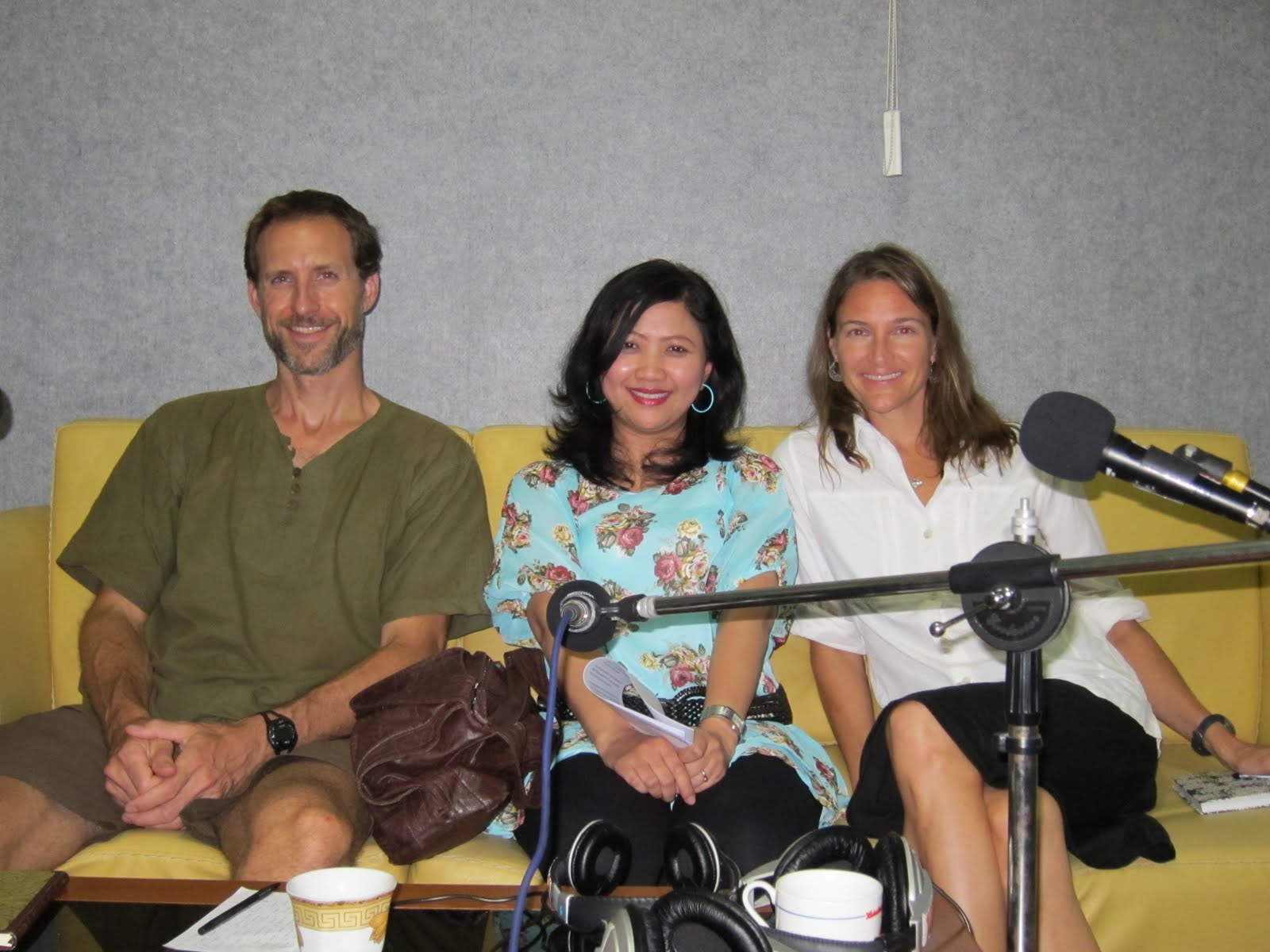
We stayed for 3 nights with Mia, Edi, and their little boy Ega in their middle-class home in the northern suburbs of Yogya. Mia is a thirty-something go-getter with a drive to succeed like no other we have met on our trip. She fights her spoiled upbringing with humanitarian pursuits and work. She and Edi don't get to spend a lot of time together. He is busy as the second-in-command at a microfinance bank, mountain biking, and playing with Ega. Mia is busy running her English School, writing books, and spending time with friends singing Karyoke! She has an amazing voice. Always a surprise around the corner with Mia. We were guests on her one-hour English radio program for Jogja English School (JES) where she interviewed us about cultural differences and our travels. One caller asked us this: “ Hi. I was wondering what you do for a living. How do you like Yogya? Do you believe in the supernatural or ghosts?”. -Uhhh...

We thank Mia for the Al Jazeera fix, the meals, and the kindness and attention she gave us. “No You Didunt...” (with neck moving side to side and fingers snapping in the air...)  Mia - eat your vegetables!

Crazy Indian and Crazier Indonesian
The last few nights we spent with Manu and Dede. Manu is Indian, and has been living in Yogya for over a year with his girlfriend Dede who is native to the area. It was with Manu and Dede that Brett and I found ourselves transported back to college, crammed into one car with eight people, reaching the nightclub by midnight. We had some amazing conversations with this unlikely pair over “goat bone soup” and thick black coffee with a hot wedge of glowing charcoal floating on top. They took us and the French gals to the banyan trees where we were blindfolded and made to walk between the two banyans in order to have our wish fulfilled. We touched the stone monument (Tugu) in the center of the city which indicates that we will return to Yogya again someday. And we learned the word Jembhut. You don't want to know. While staying with Manu and Dede we took a trip to the active volcano Merapi (last eruption was 2006!) and climbed it overnight with a steaming peak view of the sunrise the following morning. Then back to Manu's. My favorite memory of this crazy couple is riding on the back of Dede's scooter while she sang an entire Jason Mraz song about love and world peace.

Tarakan and the Lost Days
Tarakan was hard. It is a rough port town in Eastern Indonesia (Lonely Planet failed us miserably). It is a necessary evil to get to other destinations, but we stayed for four days trying unsuccessfully to plan our jungle trek into the interior. The gem in this town was meeting Dave and Joy Forney. We found Dave at Missionary Air Fellowship (MAF), a Christian organization that hires small plane pilots to live in third world countries and provide needed services. He and his wife had us over to their home for dinner and provided assistance in planning our jungle tour. They live in Tarakan with their 5 kids. They were recently given a baby gibbon (related to apes) who just wanted to hang around your neck and cuddle everywhere you went. Even Brett fell in love with that sweet little animal! Maybe since we aren't having kids, we could get a gibbon! Hee, hee!


Quentin Tarantino Moments
We seem to have one QT moment a month. The first was in the middle of the night when our overnight bus stopped at a roadside cafeteria for us to eat, somewhere in Indonesia (BFI). The lighting was yellow and dim. The music was loud and sounded like foreign elevator music. Everyone seemed to move in slow motion. A dusty old store front selling mementos, toys and kitch was open outside the restaurant door, poorly lit with a shadowy figure behind the counter.

The second QT moment was at the port in Tarakan awaiting our boat outta there. Over the loudspeaker a breathy woman spoke slow careful instructions in Indonesian while the sound reverberated eerily through the air. Motorcycles flashed by, large trucks covertly carrying goods slowly ground to a halt, and army men in fatigues piled onto the dock unloading their second-hand U.S. machine guns (M-16s), while seedy looking men lounged about the ticket counters.

The third QT moment...we watched the movie Inglorious Bastards! Disturbing.

The Plight of the Chinese
Everyone seems to marginalize the Chinese. We have started finding ourselves trying to defend the underdog. Indonesians historically have gone after the Chinese, burning their businesses and homes. The word on the street is that the Chinese either steal their business, or they cut corners and produce poorly made goods. It has been quite a theme in Asia. It resembles, in some ways, how the Jews are marginalized. Both seem to stem from the fact that both Chinese and Jews are hard-working and successful, and this creates the fear in others of being replaced or dominated. This is just an initial observation...no data here.

Ramadan
Ramadan started on August 11. What would this mean for us and our travels? Well, the call-to-prayer sounded all night that first night (seemingly). No Muslim eats or drinks during daylight hours for a month so that they may practice self-control and strength of spirit, mind and body. Many restaurants either close during the day, or just pull their door half-way closed. McDonald's, KFC, and the Chinese restaurants are open. We just have to be careful not to eat in front of people who are fasting out of respect. AND, no one can smoke all day! Heaven!

True story to illustrate what Ramadan looks like: Brett and I had hopped a 2-hour bus from the airport to Semporna one evening. The bus was full, Brett and I the only bulays. (white people or foreigners). Suddenly, on a long stretch of road lined with palm trees for as far as the eye could see, the van briskly pulled over and came to a stop. There was a flurry of activity and opening of plastic bags, paper and soda bottles. After a moment of discombobulation, we realized the call-to-eat had occurred, and all of the Muslims in our van had just been waiting for that moment to satisfy their hunger! We later were told that they only have a few minutes to get those first bites in or the devil would get in. I cannot substantiate this belief as true, though!

Diving in Mabul
For the last week we have been in far eastern Malaysia in Semporna. We were led here by our Bali dive guide who said this is one of the best places in the world to dive! We have seen some pretty cool stuff during our seven dives in two days. Cuttlefish, tons of green turtles, rockfish, leafy scorpionfish, mantis shrimp, lionfish, Indian walkman, etc. Life underwater is so weird, magical, otherworldly. But we are waiting out the better part of a week to get to the real treasure...the Sipadan dive with sharks.
The Reality of Travel
Okay. So those of you who have done this kind of travel probably warned us. But do we ever listen? Naw. Traveling the world is not so romantic. It is a lot of the mundane, interspersed with some incredible moments and experiences. It's sleeping on buses, getting stuck waiting hours at ports, being stinky and sticky, finding out after staying in a creepy dirty room for 4 nights that it was in vein because the trip you were planning fell through. Travel is easily summed up by the wisdom: Wo-man plans, God laughs. It is spending every breathing moment with the one you love, or who you thought you loved, or who just gets on your every last nerve!!! But, it is also a time for reflection. It is in the reflection that the true meaning of all this comes. It is in the crash course in communication skills with your life mate that you grow. Ya know...listen with intent, repeat back what the other person said, and acknowledge their feelings. It is about learning compromise, not just saying it, but really practicing it. Because you have to. It is a lesson in maturity, of staying cool under stress and change. It's about pushing your limits. It's about knowing the world in a different way. Knowing how China feels. Knowing how Indonesia thinks. Feeling the quiet miracle of floating near the bottom of the ocean amongst strange creatures. And of glancing at your partner with a knowing look that says, “Yeah, I know. I thought that too.”


Saturday, August 7, 2010

New and Improved Itinerary

Hi friends. As we expected, our itinerary is changing again! We have updated it to the right of our homepage. In a nutshell, we decided to go to Nepal earlier to buy time for the heat to dissipate in India and Burma.

Sooo, if you want to come meet us for some adventure, check it out! Right now we are meeting:

~Ang in India in October
~Rob and Jess in PNG and Great Barrier Reef in late December, early January
~Poppy and Moppy McCurdy in Australia in late January?
~Todd and Carrie in New Zealand in March
~Karen and Louise in South America?

Love to all. Jen

Tuesday, August 3, 2010

60 days and 29 different beds...


  1. July 27th, 2010: Welcome to Indonesia – Brett

    Ahhh, after a month of hard travel we are ready for a couple days of relaxing on the world-famous beaches of Bali. We have a lot of reading and planning to do, and a lot of writing to catch up on. Besides, this trip is supposed to be fun too, right? Maybe some snorkeling, naps on the beach, sleeping in... We both have this vision of a little bungalow on a deserted piece of sand where drinks are cheap and the water is warm.

    The best laid plans...

    1. The airport: 800 people waiting for a “Visa On Arrival” with five immigration officers working. Plus our biggest fight of the trip. Not a good start. We finally get out of there around midnight to head to our hotel on the beach.
    2. Bali: First night's hotel is kind of a dump complete with sex tourists, brownouts every two minutes, and a location that is decidedly not anywhere near the beach (but had more than it's fair share of stray dogs, both dead and alive). A quick internet search yields “Padangbai” as a “cool backpacker hangout on a crescent of white sand” about 15 miles up the coast. Sweet.
    3. Padangbai turns out to take about five hours to get to and is anything but cute. A small harbor full of tired fishing boats and a brick wall most of the way along the beach. WTF! As the sun sets on another wasted day, we order a whole pitcher of sangria made with arak (the local spirit), and drink until we feel better (not recommended – an arak buzz comes on like a freight-train). We wonder what everyone loves so much about Bali. More internet searching scores “the Gili Islands” (of Eat, Pray, Love fame) as a cute little piece of paradise just waiting for us a few islands away. It's 2.5 hours by expensive speedboat, or 6 hours by local transport. We opt for the local method and spend 9 hours getting hassled, lied to, and hearded around by various unscrupulous types whose primary job in life is to separate us from our money. We arrive on Gili Trawangan after dark – tired, irritated, with no place to stay, and really hoping for something better.
    4. Gili T: Well, we kind of have our bungalow and the beach is mostly deserted, and there are no motorized vehicles, which is nice. But we are both sick (head-cold, not intestinal), the beach is all coral (no barefoot strolls), and the prices are going to bust our budget. Time to move on to the smallest speck of white sand in the area – Gili Meno.
    5. Gili Meno, population 300 – An open air (and saltwater-only shower/tap) bungalow on a deserted beach. Finally meeting and talking to some locals (breakfast of banana crepes every morning with Denin at his little cafe that is literally in the water during high tide. Visiting the primary school in the middle of the island as a guest of Zaneur (the local teacher and horse-cart driver). Finishing our China writing. Romantic dinners of fresh fish, gado-gado, and cold beer watching the sun sink into the sea with Bali's iconic volcano, Mount Agung, in the background. Days in the sun snorkeling and napping. Wandering through the tide pools. Trading books with cool fellow travelers (Carolina from Equador). And enough time to plan a rough itinerary for our time in Indonesia. Wow – a week after ariving in Indonesia, we've finally found what we were looking for. But now it's time to move on.

    Indonesia has been like that for us. There are some gems here, for sure, but they are hard to find. China seemed to provide wonder around every corner, but Indo has been frustrating. We have definitely found some cool people and some beautiful places, but they seem to hide behind the poverty, the traffic, the hassling for money, and the oppressive heat. Our purpose is to see the world and meet its people. To learn what they think and how they feel about their place in the grand scheme of things. The language barrier is certainly part of the difficulty, but we have struggled to connect with people like we did in China. Maybe it is because most of the folks we interact with on a daily basis here are dirt-poor, service-industry people. We have so little common-ground and the obvious have-have not discrepancy makes it difficult to connect as equals. More on that later...

    In the mean-time I'm going to hit some highlights!

    1. Ubud, Bali. Like Boulder on steroids! New age center of the universe packed full of juice bars, yoga studios, and $5/hour massages. We loved it! Yes, it's touristy, but my god is it beautiful. We took dance classes, did yoga in this amazing, open-air studio in the middle of the rice paddies, took bike rides through the country side with Aspen, Colorado ex-pats Rally and Kathy (now living in Ubud running a textile business), shopped for beautiful art, attended traditional dance performances, and took another cooking class. Okay, now we're starting to see what people love about Bali.
    2. Scuba diving off Nusa Penida island (SE of Bali). Oh. My. God. Unbelievable. It's better than any promotional scuba diving film you've ever seen. While Jenny finished her certification, Brett got in a little over his head (ahem) with a group of dive masters who thought that Brett was a little more experienced than he really is (lost in translation is a common theme for us). A drift dive at 75 feet with massive currents and really strong up/down wellings – HOLY cow. Combined with the fact that I haven't been diving in ten years – well, I burned through my air in 40 minutes just trying to keep up. Second dive went much better but damn I have a lot to learn! The next day was awesome as we got to dive the wreck of the USS Liberty together near Tulamben off the NE coast of Bali. Floating upside down in 60 feet of water seeing Jenny silloueted above me in a swarm of fish next to the rusting hulk of this huge ship is an image that will remain one of those highlight memories in my brain. We even got to swim through the old cargo hold and Jenny chased a shark!
    3. Surfing on Kuta Beach. The original Indo surf spot served up perfect, long, smooth six-footers in deep water that you could ride all the way to the beach. Probably rode 40 waves in one morning. Un-freakin'-believable! (Randy H. - I did get served HARD by a ten-footer when I got a bit cocky... ouch. Reminded me of that morning in Newport.)
    4. Finding McDonalds soft-serve right on the beach in Bali. $0.22 will get you a perfect mound of cool, white perfection. For 8 cents more you can get it dipped in chocolate. Mmmmmm – our favorite late night snack (open 24 hours).
    5. Smiles everywhere. The Indonesian people love to smile. Kids, grandmas, soldiers. It's awesome and it makes you feel happy.
    6. Watching the sun rise over the smoking cone of Bromo volcano as it sits in a pool of swirling mist. Wow! We later climbed to the rim and peered down into the gaping cauldron as it spewed noxious, sulfurous steam. Volcanos just have a way of inspiring awe... Java is a land where volcanoes bring life (the most fertile soil on earth) and death (there are 20 something active volcanoes in this area, the latest eruption killed a thousand people in 2006).
    7. Our current homestay with Buti and Morni in the little village of Canderejo (bet you a hundred bucks you can't find it on Google Maps). Hint – it's in the middle of freakin' nowhere on the flanks of the (active) volcano Merapi (translates as “much fire”). Here we have played with the local kids as they prepare for the upcoming homing pigeon competition, we have ground tapioca root and pressed it into “crackers”, we have gone native (there is no TP and even if there was, there is no place to put it), and we have learned the joy of bathing each other with a small ladle and a stone basin of water. And tonight we will join the local village trance dance where I have been warned that I may try to chew glass (no drugs involved – the trance is brought on by chanting). Do you think my insurance will cover this?

    Yes, 29 different beds in 60 days can definitely take its toll. No doubt I am home-sick for family and friends and familiar food. But as I look back on the last two months it is hard to feel anything but gratitude and wonder.

    As the sun sets and the haunting call to prayer echoes out across the valley I want to thank you for being a part of this journey.

    Selemat jalan (safe journey),
    Brett and Jenny

Authenticity in Indonesia - Jenny

Brett and I set out to experience the authentic world...the real people, cultures, countries. After the first six weeks of traveling, an unsettling feeling was creeping in. Where was the connection with the locals? Our yearning to connect authentically with many people felt cheap. We are relaxing, vacationing, dining while the locals are laboring, going about their daily chores, sometimes even serving us, often just trying to make ends meet. And there is the obvious socioeconomic discrepancy that taints even the best intentions. When one is revered based solely on location of birth, and is seen as business for the tourist industry, a cynicism grows regarding any “meaningful” conversations. Also adding to the authenticity conundrum is the factor of time. In order to reap the rewards of a bilateral and equal exchange, some level of trust and relationship-building is necessary. And this sort of travel doesn't lend itself to this kind of time. If we become involved by donating money or doing volunteer work, the relationship seems more fair, but still not equal. So, we are realizing that the depth we seek may not be possible, but that we can still glean bits of connection with people everywhere we go.

The unsettling feeling doesn't stop there. Beginning in China, there seemed to be a loss of cultural soul. The Mao years stripped China of much of its character and historical traditions. But something greater than that was experienced. The elders seemed to have a resignation about them, while the younger generations seemed to have little concept of ancient Chinese culture, which appears to have been watered down by “modernity”, science, technology, and progress. Dances are staged. Works of art are replicated thousands of times over, and are being marketed as “originals”. Tourism and making the sale has stripped much dignity from the vendors, begging at every chance to not only make a sale, but to try to fool any would-be buyer into paying huge excesses over what an object is worth. Gone, I think, are the times when a traveler is invited into a local's home out of kindness, and the “find” of an original hand-made artifact is relatively non-existent. Travel, even in the smallest of towns, seems to be an industry.
Just as this world started to feel soul-less and staged, we landed in Indonesia. Still a place of richness, connectedness, authenticity. Not to be confused with pure authenticity. Bali and the Gili Islands were quite touristy. But there exists in Indonesia a pride, a deep familial thread, that binds generations and keeps the cultural torch burning brightly. In this realization, I think Brett and I began to see that our experiences will most likely vaccilate between true authenticity and the sickeningly commercial nature of tourism in all of its forms. But after Candirejo, Central Java, Indonesia, we know that authenticity and rich cultural souls still exist. Will travel in another 100 years reveal a world void of the richness and variation of “other cultures” in the face of globalization? I don't know. But I do know that it still exists in the present. And it looks much like this, during our homestay in the village of 4,000 people called Candirejo...

~I sit in a bamboo armchair in its broken yet functional seat in front of the home of Budi and Morni as the sun rises. The smell of wood burning from nearby kitchens preparing breakfast mixes with the cloud of dust filling the air from the neighbor sweeping the dirt in front of her home. With a short brittle straw broom she labors removing trash and forming clean lines on the ground, like I do with the vacuum cleaner. The small pile of litter is burned on site, and adds to the cloud. Two adolescent chickens race by my peripheral vision leading my eyes upward past the parked motorscooter, past the magenta flower-filled tree hosting the largest butterfly I have ever seen, to the random scattering of men beginning to congregate at the crossroads – men donning batik wrap-around sarongs, pressed button-down shirts, sandles, and peci, the circular felt hats that Muslim men wear. Music resembling a slow Arab folk song plays in the distance, joined by voices greeting each other with “Salamat pagi” (good morning), the occasional puttering of a 100cc motorscooter engine, and, is it? Could it be? Yes, it is...the whistle on the back of an incoming homing pigeon, signaling the upcoming pigeon competition.

Just last night we ate dinner at the simple home of Budi and Morni. They are 30 years old, and Morni is four months pregnant with their first child, a boy. Much of the food Morni prepares is fried in coconut oil...tofu with carrots and cabbage, tapioca, potatoes, and the ocassional chicken. Budi says they eat a chicken about every two weeks. I asked how they choose the chicken to be sacrificed...he responded “We take the slowest one!” After dinner Brett and I bathed in the mandi Indonesian-style bath, using a ladle to pour water from a well over our bodies in an outdoor concrete structure that shares the backyard with the chickens and goats. It is time, Budi, tells us, to go play in the gamalan orchestra, succeeded by a dance (or two) following the gamalan. Three evenings a week the villagers gather to play clangy repetitive trance-inducing music on instruments resembling drums, xylophones, and gongs. They invited Brett and me to play with them. 16 16 16 16, 56 56 56 56...I'm doing it! I'm doing it! Wait, where is 5, oh wait, 1, agghhh! We were the only foreigners present, and clearly not the best at gamelan. Next, we attended the first dance production – talented dancers in beautiful, jingly, elaborate costumes. Again, an all Indonesian audience of villagers, with lots of families and children running around. Our awkward, gangly whiteness stood several heads above the crowd. We got a lot of stares, and a lot of smiles. At a break the dancers left the stage, and the two hosts suddenly pointed to us and said something into the microphone about “the Americans” and “welcome”. The crowd of 50-100 Indos all turned to examine us.
Then we all three (Budi, Brett and myself) hop on his trusty little scooter to the next dance, a more “casual” production of locals with old worn costumes and a dirt floor. The characters came out with some semblance of order, but over the next hour would regress into a chaotic messy group of trance-dancers eating glass and fire, and falling on the ground lifeless, requiring full assistance to eventually get back on their feet . I asked the 18-year-old villager next to me of one of the men, “Is he okay?” She casually answered, “Yes, of course. The devil just took his soul.” Duh.
Not only was this finally the authenticity we craved, but the perfect paradigm of Indonesia. A Javanese village of Muslim farmers who pray five times a day in a mosque, who build homes and educate their children in ways influenced by the Dutch, whose art and dance is Hindu with relics of mysticism and animism, and whose cuisine and architecture bears a striking resemblance to the Chinese.

Authenticity revealed. The world is still pretty big.